
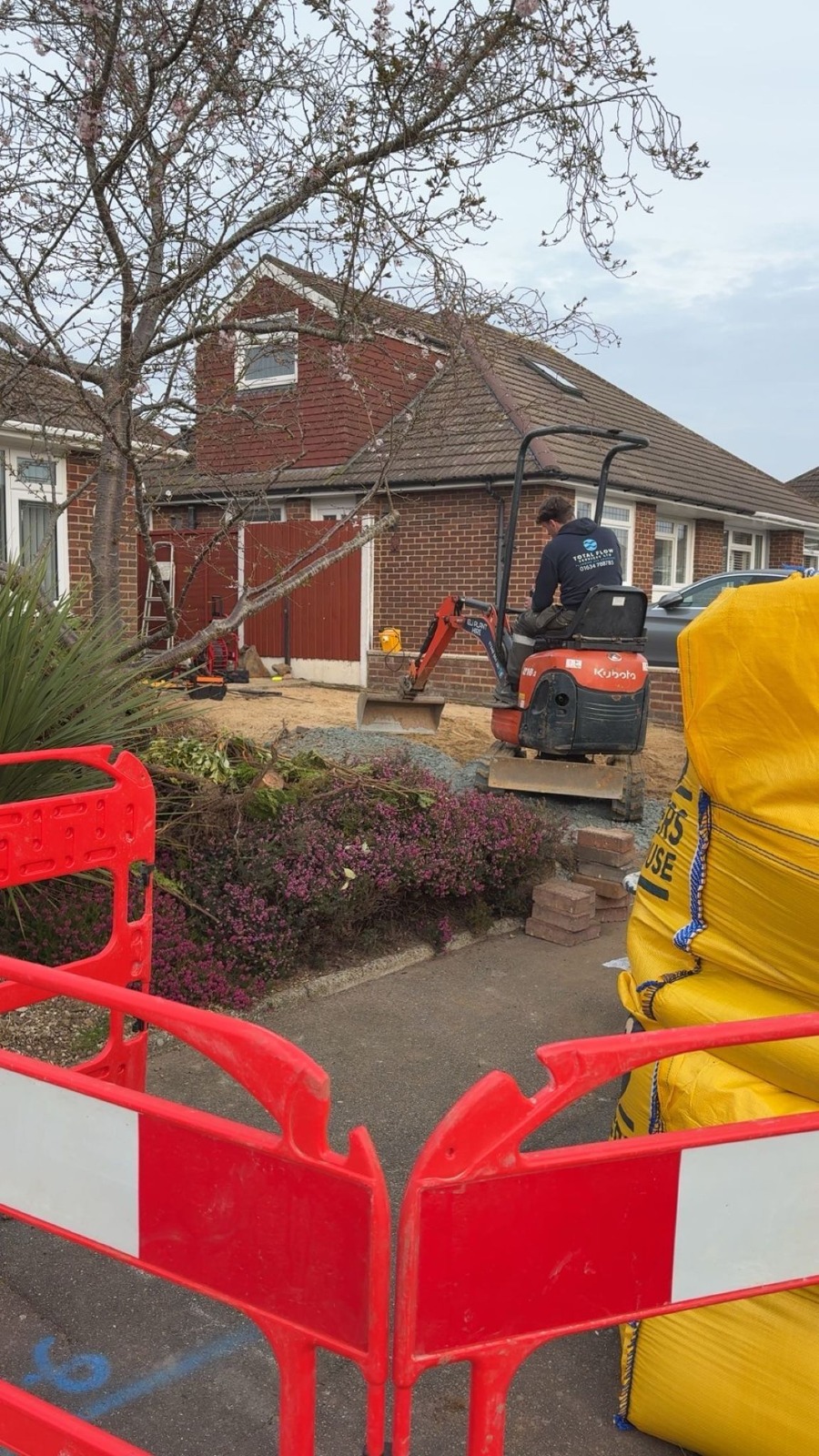
Drainage groundworks & excavation
Drainage groundworks done
by the same team that
diagnosed the problem
New drainage runs, manholes, soakaways, pump stations and full excavation across Kent. Designed, built, tested and reinstated — one team from survey to sign-off.
What it covers
Drain replacement, soakaways, manholes and full drainage installations — from a contractor who's also the plumber
Groundworks in residential drainage is a different discipline from a general builder's trench-and-fill. Falls, junctions, manhole positioning, building regulation compliance and protection from future ground movement are all engineering decisions — and getting any of them wrong is invisible until the drain blocks or backs up two years later.
We carry out full drainage groundworks across Kent and the South East: collapsed-drain replacement, new soakaway construction, pump station installation, manhole replacement and modification, new drainage runs for extensions, foul and surface water separation, and reinstatement of driveways, paths, lawns and patios after the work is done.
Because we also do the CCTV survey, the plumbing and the building control liaison, there's no finger-pointing if something goes wrong. One team, one warranty, one point of contact from initial diagnosis through to final sign-off.
What happens if you wait
Bad groundwork is the most expensive plumbing mistake — because you have to dig it up to fix it
Drainage groundworks is the part of plumbing nobody sees. That's exactly why it's the part where shortcuts are taken most often — and why the consequences are so expensive when they surface. Fixing buried mistakes means excavating again.
A drain laid too flat sits and silts; too steep and it scours solids out, leaving them to block downstream. Building Reg minimum is 1:40 to 1:80 — and it actually matters.
Undersized or wrongly positioned soakaways back up in heavy rain, flooding gardens and undermining foundations. Soakaways must be 5m+ from buildings per Building Reg Part H.
Future buyers' surveys will pick up unmapped runs, illegal connections (foul into surface water) and missing manholes — and routinely knock thousands off agreed sale prices.
Common mistakes we fix every week
- Connecting a new extension's foul waste into an existing surface water drain.
- Using a general builder for drainage runs because 'it's just digging a trench'.
- Skipping the air test on completed runs.
- Building over a drain run without rodding access or proper protection.
- Constructing a soakaway directly into clay subsoil without percolation testing.
- Failing to notify Building Control on new connections — voids future house sale.
Our process
A predictable, step-by-step system — no surprises, no upsells
- STEP 01CCTV & survey
We start with a full CCTV and condition survey so we know exactly what's there before any work is planned.
- STEP 02Design & quote
Drainage design, Building Reg compliance, fixed-price quote with full scope and reinstatement included.
- STEP 03Excavation
Safe excavation with shoring where required, services located beforehand, neighbour notification handled.
- STEP 04Install & test
New drainage installed to falls and Building Reg standards, air-tested and CCTV-verified before backfill.
- STEP 05Reinstate & sign-off
Full reinstatement of driveway, lawn or patio, Building Control sign-off, and a written warranty.
What you get
Concrete outcomes — not vague promises
Survey, design, dig, install, test and reinstate — one team, one warranty, one point of accountability.
Designed to Part H, notified to Building Control, certificate issued — protects future house sale.
Air pressure test and CCTV verification of every new run before it's covered up.
Block paving, tarmac, concrete and lawn reinstated to match — not just topped with shingle.
Full public liability and contractor's all-risk insurance on every site.
We tell you upfront what can be done as no-dig vs what genuinely needs excavating — many jobs avoid groundworks entirely.
Technical detail
What proper drainage groundworks looks like — Building Reg Part H in practice
Drainage groundworks is governed primarily by Building Regulation Part H. The rules cover pipe gradients, materials, junction types, soakaway design, manhole specification and connection notifications. Following them is what makes the difference between a drain that works for 50 years and one that fails in three.
Pipe gradients and materials
Foul drainage typically runs at 1:40 (steeper for smaller pipes, shallower for larger). Most residential work is in 110mm UPVC or, where ground movement is a concern, in EN1401 SN8 structured-wall pipe. Junctions are made with proper swept junctions — never strap-on connectors or rest-bend hacks. Bedding is 100mm of pea shingle or 10mm gravel, surround the same, with 150mm of fill before any compaction.
- 110mm UPVC for standard foul runs
- EN1401 SN8 for high-load or movement-prone ground
- Swept junctions only — no strap-on saddles
- Pea shingle bedding and surround per Part H
- Rodding access at every change of direction over 45°
Manholes and inspection chambers
Inspection chambers are required at every junction, change of direction, change of gradient, and at maximum 22m intervals on straight runs. We install Polypipe and Aquaflow plastic IC chambers for shallow domestic work and concrete sectional manholes for deeper or heavy-trafficked installations. All to Part H clearances, with proper benching and channel work.
Soakaways and surface water disposal
Soakaways must be a minimum 5m from buildings and sized by percolation test (BRE Digest 365). A typical residential soakaway is 1m³ per 50m² of roof area, but clay soils need significantly more (or an alternative disposal route). We carry out percolation tests on site before sizing — never guess. Where ground conditions are unsuitable, we'll design attenuation tanks or specify connection to a public surface water sewer.
Pump stations
Where falls don't allow gravity discharge (typical for basement bathrooms, lowered garden buildings, properties below sewer level), we install packaged pump stations — typically Jung Pumpen, Saniflo or Salamander, with dual pumps for redundancy and high-level alarm. Installations include the chamber, electrical connection (by partnered electrician), discharge pipework and commissioning.
Reinstatement
We reinstate every surface we open: block paving lifted and relaid, tarmac cut and patched (or full bay where the patch wouldn't look acceptable), concrete drives broken out and recast, lawns turfed or seeded depending on season, patios relaid to match. Quotes include reinstatement — never as an extra after the fact.
Residential vs commercial groundworks
Commercial drainage groundworks adds layers of compliance: trade effluent consents for businesses discharging non-domestic effluent, attenuation requirements for sites over a certain area, EHO-mandated grease interceptors for food premises, and oil interceptors for fuel forecourts and car washes. We hold the qualifications and insurance to work across all of these.
Frequently asked
Straight answers to the questions Kent homeowners ask us most
How much do drainage groundworks cost?+
Highly variable — a single patch repair on a collapsed clay pipe might be £1,200–£2,500 including reinstatement, while a full new drainage run for an extension can be £4,000–£12,000+. Every job is surveyed and quoted as a fixed price before work begins.
Do I need Building Control approval?+
For any new drainage connection or significant alteration, yes. We handle Building Control notification as standard, and you receive a compliance certificate on completion — important for future house sales.
How long does a typical drainage groundwork take?+
A localised patch repair is usually a single day. A new soakaway is typically 2–3 days. A full new drainage run for an extension is 3–7 days. We'll give a firm timescale in the written quote.
Will my driveway or garden be reinstated?+
Yes — fully. Block paving lifted and relaid, tarmac patched or rebayed, concrete recast, lawns turfed or seeded. Reinstatement is always included in the quote, never an extra.
Can you avoid digging up my drive?+
Often yes — for many defects, no-dig lining is a real alternative. We always quote both options where both apply, and recommend the right one based on the defect type, not what makes the bigger invoice.
Do you handle pump stations?+
Yes — Saniflo, Jung, Salamander and similar packaged pump stations for basement bathrooms, low-level extensions and below-sewer properties. Including the electrical connection, alarm and ongoing service if required.
What about shared drainage between properties?+
Shared drainage is one of the most common boundary issues we deal with. We map exactly where the shared section starts and ends, advise on Section 102 / 104 implications, and work with both property owners where consent is needed.
Do you cover building over existing drains?+
Yes — but it's regulated. Building over an existing drain requires water authority consent and specific protection details (concrete encasement, rodding access). We handle the build-over application as part of the work.
What guarantee do you provide?+
12-month workmanship guarantee on excavation and reinstatement. Materials carry manufacturer warranty (typically 25+ years for UPVC pipework). For lined repairs, the lining itself carries a 25-year design life.
Do you cover commercial sites?+
Yes — including grease interceptor installation, attenuation tanks, surface water management and pump stations on commercial and industrial premises across Kent and the South East.
Related services
Drainage groundworks done once, done right.
Survey, design, dig, install, test and reinstate — one team from start to sign-off. Building Reg compliant, fixed price, full reinstatement included.
Fully insured · Workmanship guarantee · 7 days a week