
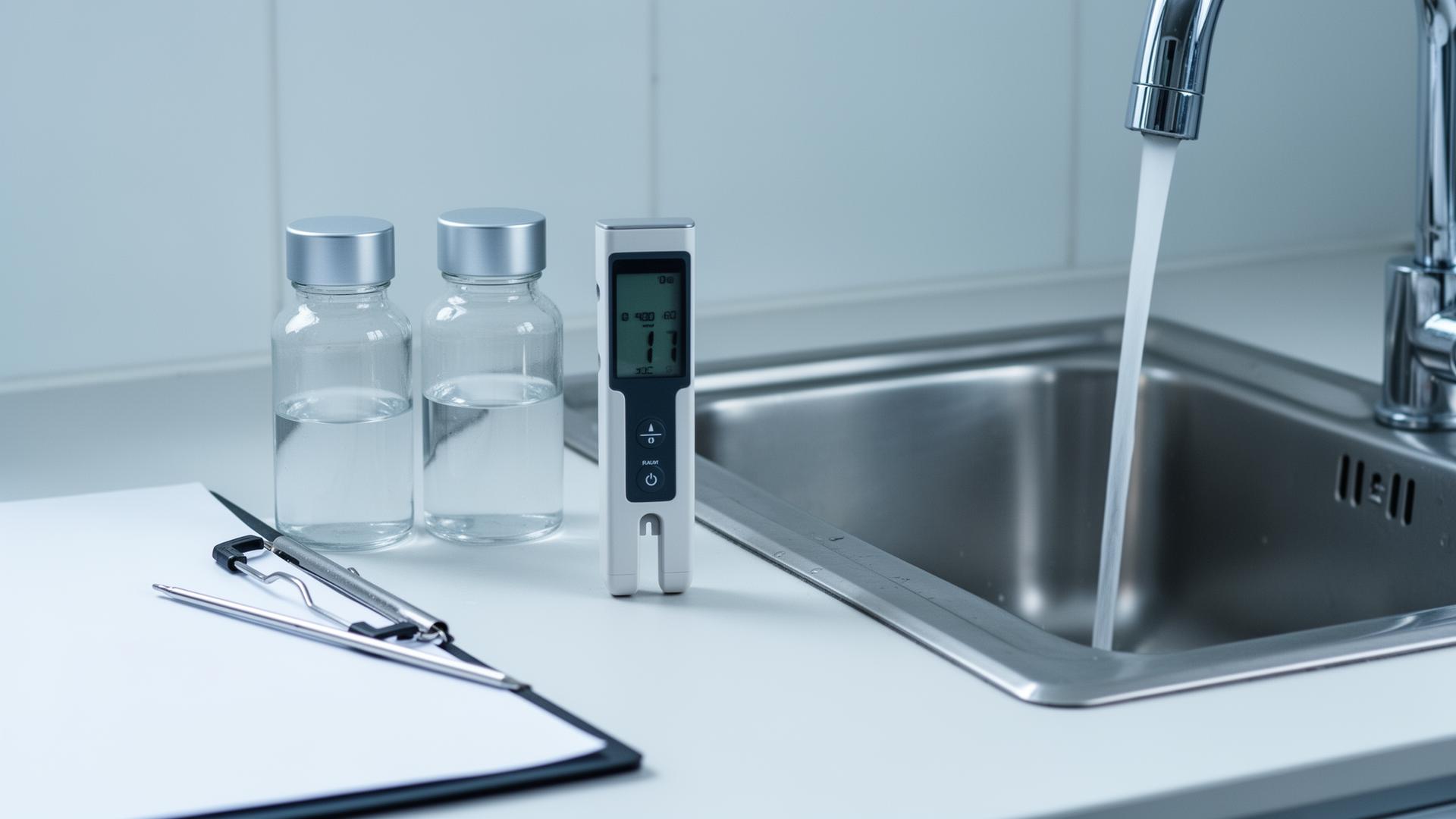
Legionella risk assessment & testing
Legionella risk assessment
and water sampling that
actually meets HSE L8
Legionella risk assessments, water sampling and remediation across Kent — for landlords, care homes, schools, gyms, hotels and commercial water systems. HSE L8 and HSG274 compliant.
What it covers
Legionella risk assessments, sampling, remedial works and ongoing compliance — for landlords and commercial duty holders
Under the Health & Safety at Work Act 1974 and the Approved Code of Practice L8, every duty holder responsible for a water system has a legal obligation to assess and control the risk of legionella. That includes landlords (residential), care home managers, school estates managers, hotel and B&B owners, dental practices, gyms, leisure facilities and any commercial premises with hot and cold water systems.
Our service covers the full compliance lifecycle: initial legionella risk assessment to HSG274 standards, water sampling with UKAS-accredited laboratory analysis, remedial works (thermal disinfection, chlorination, dead-leg removal, expansion vessel replacement), and ongoing monitoring programmes that satisfy your duty of care.
We work with single-property landlords, letting agents with portfolio responsibilities, care home groups, multi-academy trusts and commercial estate managers across Kent and the South East. Documentation is digital, time-stamped, and ready for HSE inspection or insurance audit.
What happens if you wait
Legionnaires' disease is fatal in roughly 10% of cases — and the legal liability sits with the duty holder
Legionnaires' disease is a severe form of pneumonia caused by inhaling water droplets containing legionella bacteria. The HSE prosecutes failures to control it as criminal breaches under the Health & Safety at Work Act — unlimited fines, custodial sentences and personal liability for directors and trustees.
HSE prosecution under H&SWA 1974 carries unlimited fines and potential custodial sentences for individuals personally responsible.
An outbreak typically generates multiple personal injury claims. Insurance frequently refuses cover where evidence of risk assessment is absent.
For care homes, schools, hotels and gyms, a single confirmed case is often business-ending. The HSE publishes prosecutions publicly.
Common mistakes we fix every week
- Assuming the responsibility is the water company's — it isn't, it's the duty holder's.
- Treating L8 as an annual tick-box rather than an ongoing control scheme.
- Letting hot water cylinders sit below 60°C to save energy.
- Ignoring dead-legs and unused outlets — they're the highest-risk areas in any system.
- Reusing a five-year-old risk assessment after major plumbing changes.
- Buying online 'home test' kits and treating the result as legally valid evidence.
Our process
A predictable, step-by-step system — no surprises, no upsells
- STEP 01Initial consultation
We confirm building type, water system layout, occupancy and any prior assessments.
- STEP 02On-site risk assessment
Full HSG274-compliant survey: system schematic, temperature checks, dead-leg identification, photographic record.
- STEP 03Water sampling
Where required — outlets sampled and dispatched to UKAS-accredited lab. Results within 10–14 days.
- STEP 04Written report
Risk rated by outlet and system, with prioritised remedial actions and timeline.
- STEP 05Remediation & monitoring
We carry out remedial works and set up ongoing monitoring schedule (typically monthly, quarterly or annual).
What you get
Concrete outcomes — not vague promises
Reports, sample results and control scheme formatted for HSE inspection and insurance audit.
City & Guilds qualified in legionella risk assessment and HSG274 control of legionella bacteria.
Samples processed at UKAS-accredited laboratories — independent, defensible results.
Assessment, sampling, remediation and ongoing monitoring from one provider — no coordination headaches.
Dashboard access for letting agents, care groups and estate managers across multiple sites.
Annual reassessment, monthly temperature monitoring and audit dates managed proactively.
Technical detail
What full L8/HSG274 compliance actually looks like in a Kent care home, school or letting portfolio
Legionella compliance is misunderstood mainly because the documentation is dense and the responsibility unclear. In practice, the framework is straightforward: identify the duty holder, assess the risk, control it, monitor it, and document everything. Here's what each step involves.
The duty holder
The 'duty holder' is the person legally responsible for the water system. For commercial premises this is usually the employer or building owner. For rented residential property this is the landlord. For care homes, schools and shared facilities, it's typically the registered manager or trust. The duty cannot be delegated — only the technical work can be outsourced.
What a compliant risk assessment includes
Per HSG274, the assessment must include: a schematic of the hot and cold water system, identification of all assets and outlets, calorifier and storage details, temperature checks at sentinel outlets, identification of dead-legs and infrequently used outlets, an evaluation of risk by area, and a written, dated, signed report with a recommended control scheme.
- Full system schematic and asset register
- Sentinel and representative outlet temperature checks
- Dead-leg and unused outlet identification
- Calorifier (hot water cylinder) temperature and condition
- Cold water storage condition, lid integrity and temperature
- Risk-rated written report and prioritised remedial actions
Sampling — when it's needed and when it isn't
Routine sampling is required where: temperature control cannot reliably be maintained, the population is at higher risk (care homes, hospitals, vulnerable residents), or in response to a positive result or suspected outbreak. For most low-risk residential settings, risk assessment and temperature monitoring alone are sufficient. We advise based on your specific system — not a blanket sales upsell.
Ongoing monitoring
For commercial duty holders, a written control scheme typically includes monthly sentinel temperature checks, weekly flushing of low-use outlets, annual showerhead descaling and disinfection, quarterly cold water storage checks, biannual calorifier checks and full reassessment every two years (or after any significant system change). We manage this on your behalf where you'd prefer one fewer thing to track.
Remedial works we carry out
Where assessment identifies failings, we carry out the remediation: thermal disinfection (raising the system to 70°C for 5 minutes at every outlet), chemical disinfection where thermal is impractical, dead-leg removal, TMV servicing and disinfection, expansion vessel replacement, calorifier descaling and tank disinfection.
Frequently asked
Straight answers to the questions Kent homeowners ask us most
Do I legally need a legionella risk assessment as a landlord?+
Yes. The HSE expects every residential landlord to assess and control legionella risk. For most low-risk domestic lets the assessment is brief and unlikely to require sampling — but the documented assessment is a legal requirement, not optional.
How often does it need to be reviewed?+
Risk assessments must be reviewed periodically and after any significant change to the water system. Industry practice is every two years for low-risk residential and annual for higher-risk premises (care homes, schools, hotels, gyms).
What's the difference between a risk assessment and water sampling?+
Risk assessment is the desktop and on-site evaluation of how legionella could colonise the system. Sampling is laboratory testing of actual water for bacterial presence. Most low-risk systems need only assessment and temperature control; sampling is reserved for higher-risk settings or in response to a problem.
How much does a legionella risk assessment cost?+
Residential single-property assessments are a low fixed fee. Commercial and multi-property assessments are quoted after a brief consultation to confirm size and complexity. Multi-property portfolios attract discounted unit pricing.
How long does an assessment take?+
A single residential property is typically 60–90 minutes on-site, with the written report issued within 5 working days. Larger commercial premises are quoted on time and complexity.
What if the assessment finds a problem?+
We document it, risk-rate it and quote the remediation as a fixed price. You're never obliged to use us for the works — many clients do, simply because the same engineer team can complete the loop quickly.
Do you cover care homes and schools?+
Yes — these are core sectors for us. Full HSG274 assessments, written control schemes, monthly monitoring programmes and remedial works. Documentation formatted for CQC, Ofsted and HSE inspection.
Will you flush a void property before re-letting?+
Yes. After any period of stagnation (typically 7+ days), the system should be flushed and ideally sampled before re-letting. We provide this as a fixed-fee service for letting agents.
Are you qualified?+
Yes — City & Guilds qualified legionella risk assessors, working to HSE L8 ACOP and HSG274 guidance. We carry £5M public liability and full professional indemnity.
Can you set up ongoing monitoring?+
Yes. For commercial duty holders we offer scheduled monthly temperature monitoring, annual reassessment, and digital dashboard access to all records and certificates.
Related services
Get HSE-compliant — properly, once, with documented evidence.
Risk assessment, sampling, remediation and monitoring from one team. Single-property landlords through to multi-site portfolios across Kent and the South East.
Fully insured · Workmanship guarantee · 7 days a week