
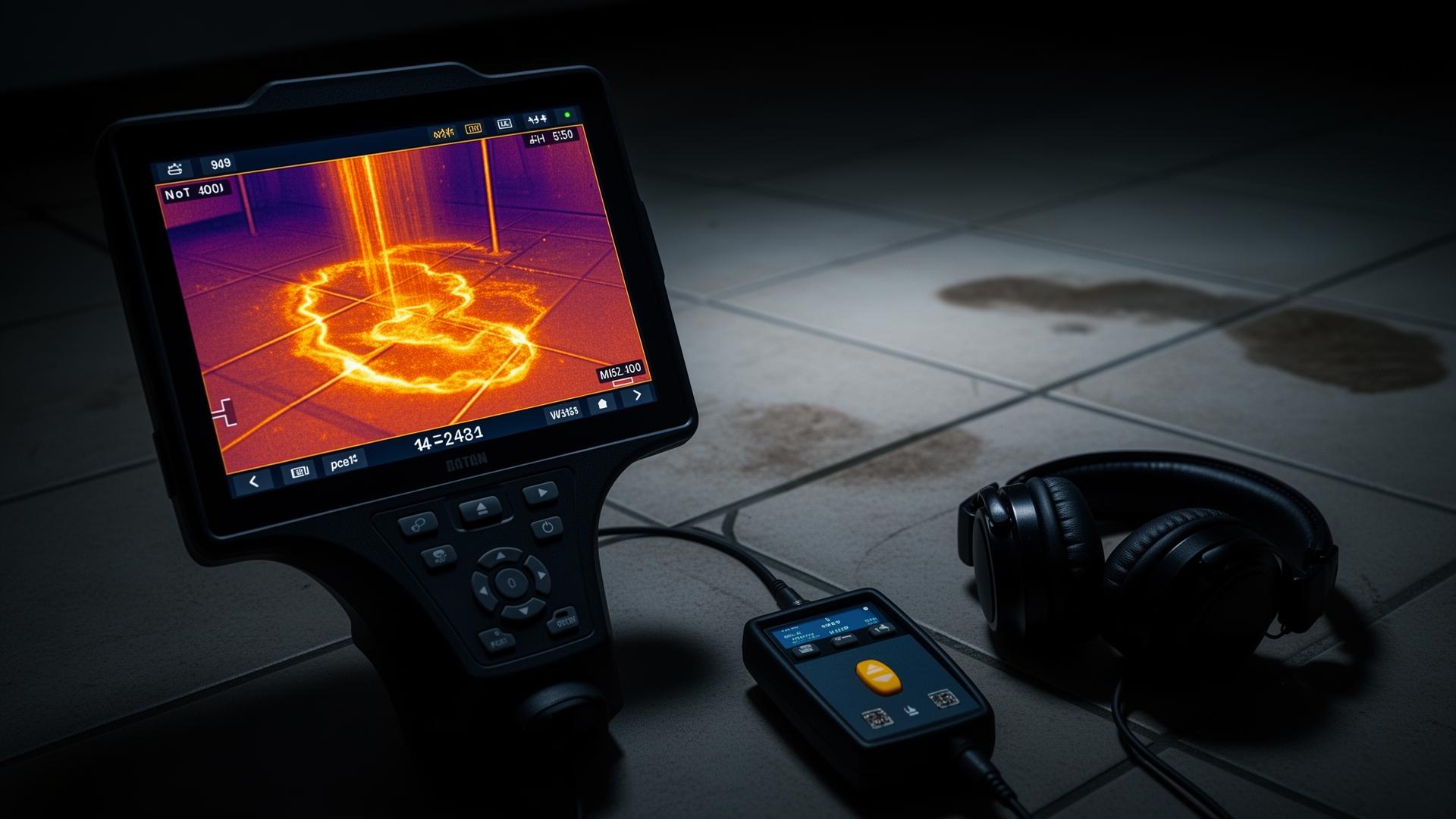
Non-destructive leak detection
Find the leak without
destroying the kitchen
looking for it
Acoustic, thermal and tracer gas leak detection across Kent. We locate hidden leaks to within centimetres — under floors, behind walls, in screeds — before anyone picks up a chisel.
What it covers
Acoustic, thermal and tracer-gas leak detection — accurate, non-invasive and insurer-grade
Most leaks aren't where the damage is. Water travels along joists, runs down pipework, soaks through screed and emerges feet — sometimes metres — from the actual source. Smashing through walls and floors to look for it is expensive, slow and almost always wrong on the first attempt.
Our leak detection uses calibrated equipment to pinpoint the source precisely before anything gets opened up. Acoustic correlation for pressurised pipes, thermal imaging for underfloor heating loops and hot water mains, tracer gas for inaccessible runs, and moisture mapping to confirm the spread. The result is a report telling you exactly where to dig — or, more often, where not to.
We work for homeowners, landlords, insurers and loss adjusters across Kent and the South East. Reports are written to insurance standards and accepted by every major UK home insurer.
What happens if you wait
An undetected slow leak is the single most expensive plumbing problem in UK homes
ABI data consistently puts escape of water in the top three causes of home insurance claims, with the average claim now over £8,000. The damage almost always exceeds the cost of the leak. Finding it quickly and accurately is the single biggest variable in how much it ends up costing.
Long-running leaks rot joists, blow plaster, ruin floors and warp doors. A few weeks of dripping turns a £200 repair into a £6,000 strip-out.
Insurers increasingly require professional trace-and-access reports. A 'we thought it was the boiler' explanation rarely settles claims cleanly.
Hidden moisture behind walls and under floors feeds mould within weeks. Affects respiratory health and is expensive to remediate properly.
Common mistakes we fix every week
- Topping up the boiler pressure every few days for months without investigating the cause.
- Hacking off plaster to 'have a look' before locating the leak properly.
- Assuming a damp patch is condensation when it's actually a live leak running down a wall cavity.
- Not informing insurers early — many policies require notification within 30 days.
- Using a plumber with a moisture meter and calling it 'leak detection'.
- Replacing a kitchen floor before confirming the leak is actually fixed.
Our process
A predictable, step-by-step system — no surprises, no upsells
- STEP 01Telephone triage
We take the symptoms, photos and any previous reports — most jobs are diagnosed before we arrive.
- STEP 02Site survey
Visual inspection, pressure test on the affected circuit and moisture mapping of the area.
- STEP 03Locate with equipment
Acoustic correlation, thermal imaging or tracer gas — chosen for the system and access.
- STEP 04Mark & report
Exact location marked on the floor or wall, with a written report and photographs.
- STEP 05Fix it (or hand back)
We repair on the same visit where possible — or hand the report to your insurer or builder with confidence.
What you get
Concrete outcomes — not vague promises
Locate leaks to within centimetres before anyone opens a wall or lifts a floor.
Written and photographic evidence accepted by every major UK home insurer.
A professional trace-and-access report typically halves the time from claim to settlement.
Smaller excavations = smaller make-good costs. The detection often pays for itself.
Most surveys completed in a single visit, with a verbal answer before we leave.
If it's condensation or historic damp, we'll tell you — and not bill you for a 'leak repair' that didn't need doing.
Technical detail
How modern leak detection actually works — and why the kit matters
The phrase 'leak detection' covers everything from a £30 moisture meter to a £15,000 thermal camera. The right tool for the job depends on the type of leak, the system, and the access. Using the wrong tool finds nothing — or, worse, finds the wrong thing.
Acoustic leak correlation
Pressurised water pipes leak with a distinctive frequency. Sensors placed on accessible contact points (taps, valves, manifolds) correlate the sound and triangulate the source. Most accurate on metallic pipework, including copper and steel mains. Particularly effective on incoming water supplies, mains pipework and pressurised central heating circuits.
Thermal imaging
Calibrated thermal cameras reveal temperature differences invisible to the eye. Used to locate underfloor heating leaks (warm water leaking shows as a clear thermal anomaly), hot water main leaks, and the spread of damp where moisture has cooled walls or floors. Essential for diagnosing underfloor heating before lifting any flooring.
Tracer gas leak detection
A safe hydrogen/nitrogen blend (5% H₂ / 95% N₂) is introduced to the depressurised circuit. The gas escapes through any leak point and rises through floors, screed or substrate. A surface-sniffing detector then locates the exit point precisely. Particularly effective for buried pipework, concrete slabs and inaccessible runs.
Moisture mapping and salt analysis
Calibrated moisture meters and pinless capacitance scanners map the actual extent of moisture in a wall or floor. Combined with salt analysis where needed, this distinguishes between a live leak, rising damp, penetrating damp and condensation — critical for accurate insurance reporting and for knowing what to actually repair.
Insurance trace-and-access work
Most UK home insurance policies include 'trace and access' cover — the cost of locating and exposing a leak (separate from the cost of fixing the leak itself). Our reports are written to insurer standards and we work directly with loss adjusters across all major UK insurers. We'll guide you through the claim process if useful.
Frequently asked
Straight answers to the questions Kent homeowners ask us most
How much does leak detection cost?+
A standard non-invasive leak detection survey on a single property is a fixed fee, including site visit, equipment, location marking and a written report. Larger sites or multiple leaks are quoted after a brief phone consultation.
Is leak detection covered by home insurance?+
Most UK policies include 'trace and access' cover for the cost of locating a leak. We can advise on whether your specific policy covers it and provide an invoice formatted for claim submission.
How accurate is leak detection?+
Acoustic methods typically locate to within 10–20cm. Thermal imaging on underfloor systems is often within centimetres. Tracer gas is the most accurate for buried pipework. We confirm before any excavation begins.
Do I need to drain my system?+
Not for a survey — we test the system as it is. If tracer gas is required for an inaccessible leak, we depressurise that circuit only and re-pressurise on completion.
Can you find leaks under concrete or tiled floors?+
Yes. Tracer gas is specifically designed for buried pipework, and thermal imaging picks up leaks under tiles, screed and engineered wood — without lifting any of it.
Will you fix the leak the same day?+
Often, yes — if the leak is accessible and the parts are stocked on our van. Underfloor or in-wall repairs may need a separate visit but are quoted as a fixed price before we leave.
Do you provide reports for insurers?+
Yes. All our reports are written to the format expected by major UK home insurers, with photographs, equipment used, location details and recommended remedial work.
My boiler keeps losing pressure — is that a leak?+
Almost always yes. The leak is often microscopic and on a pipe joint, radiator valve, or underfloor loop. Our standard survey will locate the source even when there's no visible water.
Can you detect leaks in underfloor heating?+
Yes — this is one of the most common surveys we run. Thermal imaging and pressure isolation of individual zones lets us identify the failing loop without lifting the floor.
How quickly can you attend?+
Most leak detection surveys are booked within 24–48 hours. Emergency surveys (active uncontrolled leaks, no heat in winter) we'll attend same-day where possible.
Related services
Find the leak today — without smashing the house up.
Same-day surveys across Kent. Insurance-grade reports, location to within centimetres, repair quoted before we leave site.
Fully insured · Workmanship guarantee · 7 days a week