Water softeners & filtration
End limescale damage
with water treatment
sized for Kent's hard water
Kent has some of the hardest water in the UK. Salt-based softeners, scale inhibitors and whole-house filtration installed properly — protecting boilers, kettles, showers and skin.
What it covers
Whole-house water softeners, scale inhibitors and drinking water filtration — chosen for your water, not from a catalogue
Kent sits on chalk. The water is excellent to drink but among the hardest in the UK — typically 300–400ppm calcium carbonate. Over a decade, that hardness fur-coats every appliance in the house: kettles, showers, washing machines, dishwashers, immersion heaters and — most expensively — the heat exchanger in your boiler.
Water softening properly installed cuts that scale to zero. Hair softer, skin less dry, less detergent needed, appliances lasting longer, and a measurable reduction in gas usage as boilers stop fighting through layers of limescale. The maths is well established: most Kent households recover the softener cost in 5–7 years on detergent and appliance lifespan alone.
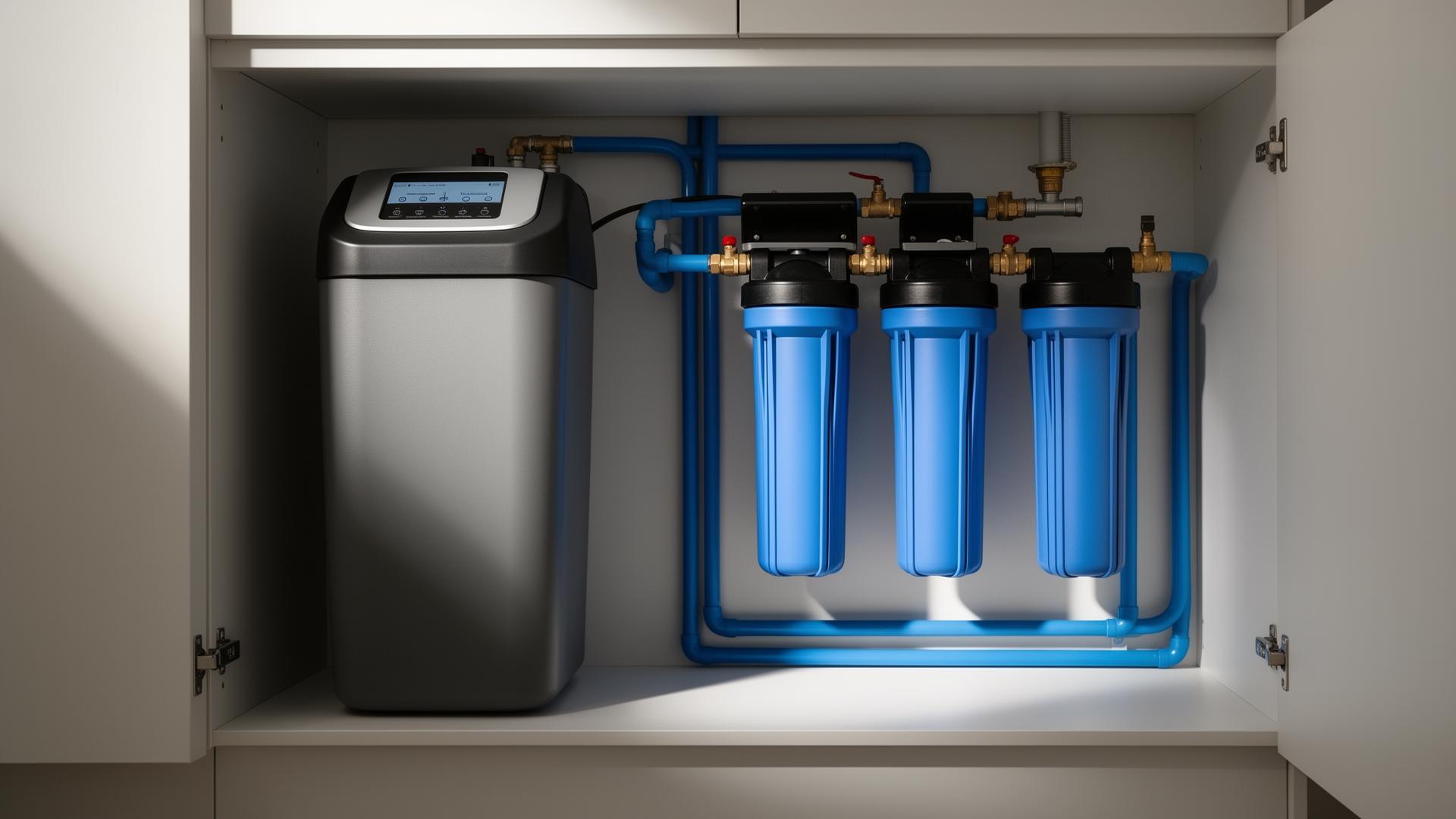
We also install drinking water filtration — under-sink reverse osmosis, carbon block filters and whole-house chlorine removal — and scale inhibitors where a full softener isn't the right fit. Every install is sized to your specific water test, household size and pipework — not a one-size catalogue spec.
What happens if you wait
Hard water is slowly destroying everything that heats it
Limescale doesn't announce itself. It builds invisibly inside boilers, immersion heaters, dishwashers and kettles — until performance drops, bills creep up and an appliance fails three years early. By the time you notice, you've already paid for it.
Limescale on a heat exchanger forces the boiler to work harder and run hotter. A 12-year unit becomes a 6-year unit. Heat exchangers cost £600–£1,200 to replace.
Washing machines, dishwashers and kettles in hard water areas typically last half as long as in soft water areas. The Whirlpool and Bosch service data is unambiguous.
Hard water is widely associated with eczema flare-ups and dry hair. Many dermatologists in the South East routinely recommend softening.
Common mistakes we fix every week
- Buying an undersized softener for a 5-person household because it was £200 cheaper.
- Installing a softener without a separate unsoftened tap for drinking and cooking.
- Not commissioning the bypass and regeneration cycle properly.
- Putting a softener on a property with an existing brass-fitting leak that wasn't addressed first.
- Believing that magnetic 'descalers' do anything measurable in independent testing.
- Forgetting to top up salt — and being surprised when limescale returns.
Our process
A predictable, step-by-step system — no surprises, no upsells
- STEP 01Water test & survey
We test your water hardness on-site and survey the install location — usually the kitchen or utility cupboard.
- STEP 02Sized recommendation
Softener size matched to household size, water usage and pipework. Quoted as a fixed price.
- STEP 031-day install
Unit fitted, bypass valves added, separate drinking water tap installed at sink.
- STEP 04Commission & demonstrate
Regeneration programmed, soft water tested at the tap, salt loading and maintenance explained.
- STEP 05Aftercare & service
Service reminders, salt delivery options, and a 12-month workmanship guarantee.
What you get
Concrete outcomes — not vague promises
Boiler, dishwasher, washing machine, shower heads and kettles stay scale-free indefinitely.
Scale-free heat exchangers transfer heat efficiently — typically 5–10% lower gas consumption.
Soft water lathers — most households cut detergent use by 40–50%. It pays the salt cost many times over.
Particularly noticeable for eczema-prone skin, treated hair and young children.
Manufacturer data consistently shows 30–50% longer lifespan for appliances in soft water areas.
No more limescale rings on taps, glass, toilets and shower screens. Cleaning time drops materially.
Technical detail
What proper water treatment in a Kent home actually involves
Water treatment is a category that ranges from genuine, measurable engineering to outright pseudo-science. Knowing which is which — and what's right for your property — matters before spending money on it.
Ion-exchange water softeners (the only proven 'softening' technology)
Salt-based ion-exchange softeners swap calcium and magnesium ions for sodium ions, removing the minerals that cause scale. This is the only technology that genuinely produces soft water (under 50ppm) — every independent test agrees. The good units (Harvey, Kinetico, EcoWater) are twin-cylinder, non-electric, meter-controlled and regenerate only when needed.
- Twin-cylinder design — continuous soft water, no overnight regeneration
- Meter-based regeneration — uses water consumption, not a timer
- WRAS-approved with full UK pipework compliance
- Block salt loading — no heavy bags to lift
Scale inhibitors (a different category)
Scale inhibitors don't remove hardness — they modify it so it doesn't deposit. Phosphate-dosed cartridges and template-assisted crystallisation are the two proven technologies. Useful where a full softener isn't possible (flats, listed buildings, no plumbing space) but always inferior to true softening on results.
Drinking water filtration
Most Kent water is excellent quality from the tap and doesn't need additional filtration for safety. People install drinking filtration mainly for chlorine taste, lead removal in older pipework, or simple preference. Options include under-sink carbon filters (taste/chlorine), reverse osmosis (everything), and whole-house chlorine filtration.
Whole-house vs point-of-use
A whole-house softener treats every tap in the house except a dedicated unsoftened drinking tap (we always install one — softened water has slightly raised sodium and isn't ideal for infant formula). Point-of-use filters fit at a single tap, usually the kitchen, for drinking water improvement.
What doesn't work
Magnetic and electronic 'descalers' have repeatedly failed independent peer-reviewed testing. They are not water softeners and any 'softening' claims are marketing rather than measurable. We don't sell or install them.
Frequently asked
Straight answers to the questions Kent homeowners ask us most
How much does a water softener cost in Kent?+
A quality twin-cylinder softener (Harvey, Kinetico, EcoWater) typically falls in the £1,800–£2,800 range installed, including all pipework, bypass valves, drinking water tap and commissioning. Sized to your household and quoted as a fixed price.
Is Kent water really that hard?+
Yes. Most Kent supplies measure 300–400ppm calcium carbonate, comfortably in the 'very hard' category. Soft water is generally considered under 50ppm — so Kent is 6–8x harder than soft water areas.
Will softened water taste salty?+
No. Softening removes calcium and magnesium and replaces them with sodium — the increase in sodium is small and not detectable on taste. That said, we always install a separate unsoftened tap at the kitchen sink for drinking, cooking and infant formula.
How often do I need to add salt?+
Typically every 6–10 weeks for a family of four, depending on water usage. We use block salt for ease of handling — no heavy bags.
Will a softener void my boiler warranty?+
No — quite the opposite. Most manufacturers actively recommend softening in hard water areas to protect the heat exchanger. We can confirm specifics for your boiler brand on request.
Do magnetic and electronic descalers work?+
No. They've failed every independent peer-reviewed test we're aware of. We don't sell or install them, and we'd recommend caution with any company that does.
Can a softener be retro-fitted easily?+
Yes in most properties. The unit fits under a kitchen sink or in a utility cupboard, requires a 13A socket (most models) and a drainage point. Typical install is one day.
Does soft water damage pipework?+
Modern softeners produce water within all WRAS pipework compatibility limits. There's no impact on copper, plastic or stainless steel pipework when correctly installed.
Will I save money on bills?+
Yes, typically. Lower detergent use, longer appliance life and 5–10% lower gas usage on a scale-free boiler add up. Most households break even on cost within 5–7 years and save money thereafter.
Can you install softeners in commercial premises?+
Yes — salons, cafés with espresso machines, dental practices and small offices are all common installs. Sized to flow rate and treated water demand, with WRAS compliance and any required category-3 backflow protection.
Related services
Stop limescale damaging your home and appliances.
Free home water test and survey. Twin-cylinder softeners sized for your household. Fixed-price quote, 1-day install, 12-month workmanship guarantee.
Fully insured · Workmanship guarantee · 7 days a week